The History of Projective Techniques
From 17th-century parlor pastimes to standardized psychodiagnostic science: How ambiguous visual stimuli evolved into profound empirical windows into the human unconscious, defense mechanisms, and bodily somatoperception.
Inkblots as Art, Amusement & Poetic Reverie
Long before inkblots entered psychiatric hospitals or diagnostic manuals, ambiguous symmetrical ink patterns captured the imagination of artists, polymaths, and poets across Europe. In 1671, the German Jesuit scholar Athanasius Kircher (1602–1680) documented in his encyclopedic work Ars Magna Lucis et Umbrae (The Great Art of Light and Shadow) how dripping ink onto paper, folding it in half, and pressing it produced startlingly symmetrical patterns resembling fantastical beasts, anatomical structures, and celestial landscapes. Kircher viewed these as playful demonstrations of nature's inherent geometric harmonies.
By the mid-19th century, the creation of folded inkblots evolved into a popular parlor game known across German-speaking territories as Klexographie (or Kleksographie). In 1857, the renowned German physician, poet, and medical occultist Justinus Kerner (1786–1862) published his seminal literary volume Kleksographien (Inkblotographies). Kerner created accidental inkblots and discovered that prolonged gazing prompted profound, involuntary subjective visions from the unconscious mind.
First documented bilateral paper-folding inkblot technique, exploring symmetry in nature and optics.
50 inkblots and accompanying poems in Kleksographien, presaging psychological projection.
French Symbolist poets utilize ambiguous ink forms as portals into subconscious dream imagery.
Psychology Enters the Scene: Linking Perception to Character
As psychology broke away from philosophy to establish itself as an empirical laboratory science in the late 19th century, researchers began asking: Can responses to ambiguous chance designs reveal measurable differences in human personality?
In 1875, German physician and writer Karl Ludwig Robert (1838–1898) published Robert's Klecksography, presenting 20 colored inkblot plates accompanied by interpretive guidelines. Robert was the first to systematically observe that individuals of differing temperaments responded in characteristically distinct ways: pragmatic, realistic thinkers saw simple tools and animals, while poetic, imaginative, or neurotic subjects produced intricate, emotionally charged interpretations.
A decisive methodological leap occurred in France through Alfred Binet (1857–1911), co-creator of the first practical intelligence scale. In 1886, Binet and his collaborator Théodore Simon introduced inkblots into experimental psychology to investigate children's creative imagination, mental fatigue, and perceptual speed. In L'Étude Expérimentale de l'Intelligence (1904), Binet remarked: "The blots awaken ideas which are not logical, but which come from the depths of the subject's personality."
Published 20 colored inkblots with diagnostic guidelines; first to link inkblot responses to temperament.
Introduced inkblots into experimental child psychology to assess imagination and cognitive depth.
Pioneered clinical inkblots to differentiate hysterical somatic symptoms from organic neuroses.
Hermann Rorschach & The Burghölzli Revolution
At the famous Burghölzli Psychiatric Hospital in Zurich, Switzerland, under the mentorship of director Eugen Bleuler (who coined the term schizophrenia) and alongside Carl Jung's word-association research, a young Swiss psychiatrist named Hermann Rorschach (1884–1922) united artistic intuition with clinical psychiatry. As a schoolboy, Rorschach was so fond of making inkblots that his classmates nicknamed him Klex (Inkblot).
In 1917, Bleuler's student Gustav Hens published a doctoral dissertation entitled Über Formdeutungen beim Kleckssehen (On Form Interpretations in Inkblot Seeing), categorizing responses across 60 subjects by form accuracy, movement, and content. Rorschach recognized the immense diagnostic power of this approach but realized Hens had missed the crucial insight: inkblot testing was not primarily a test of imagination, but an objective experiment in perceptual apperception.
Between 1918 and 1920, Rorschach rigorously administered 15 to 40 cards to over 300 individuals (including 188 schizophrenic patients, manic-depressives, and healthy controls). He developed objective scoring criteria based on Determinants:
In 1921, Rorschach published his masterwork, Psychodiagnostik, along with his standardized set of 10 diagnostic plates (5 monochrome, 2 black-and-red, and 3 multicolored). During publication, a fortuitous printing mishap washed out the solid black inks, producing accidental subtle shades of grey. Rorschach immediately recognized that this printing artifact added vital diagnostic depth, enabling the measurement of shading and anxiety. Tragically, only 9 months after publication, Dr. Hermann Rorschach died of peritonitis resulting from a ruptured appendix at age 37, leaving the psychological world to carry forward his legacy.
The Thematic Apperception Test & The Projective Hypothesis
In the 1930s, projective psychology crossed the Atlantic. In 1935, at the Harvard Psychological Clinic, Henry A. Murray (1893–1988) and artist Christiana Morgan (1897–1967) introduced the Thematic Apperception Test (TAT). Unlike inkblots, the TAT presented structured, evocative interpersonal scenes, instructing the subject to narrate: What led up to this? What is happening now? What are the characters feeling and thinking? What will the outcome be? Murray decoded these narratives using his theory of Needs (internal drives such as Achievement, Affiliation, Dominance) and Press (environmental forces, hostility, or support).
In 1939, philosopher and social scientist Lawrence K. Frank published his monumental paper "Projective Methods for the Study of Personality" in the Journal of Psychology. Frank provided the unified theoretical umbrella:
During this golden age, five major competing American scoring systems emerged for the Rorschach, led by Samuel Beck (empirical, normative rigor), Bruno Klopfer (Gestalt, psychoanalytic nuance), Marguerite Hertz, Zygmunt Piotrowski, and David Rapaport at the Menninger Clinic.
Wayne Holtzman & John Exner's Comprehensive System
By the late 1950s, projective tests faced mounting academic criticism regarding inter-rater reliability, varying response totals ($R$), and lack of standardized administration norms. In response, psychometricians spearheaded two landmark methodological innovations:
In 1961, Wayne H. Holtzman developed the Holtzman Inkblot Technique (HIT) at the University of Texas. The HIT utilized two parallel sets of 45 cards with a standardized constraint of strictly one response per card, successfully eliminating the confounding influence of verbosity and producing psychometrically sound split-half and test-retest reliability coefficients.
In 1974, John E. Exner Jr. (1928–2006) published The Rorschach: A Comprehensive System (CS). Exner integrated the best empirical features from Beck, Klopfer, Hertz, and Piotrowski into a standardized administration, inquiry, and structural summary protocol supported by a massive normative database of over 10,000 protocols. Exner's work solidified projective testing as an empirical cornerstone in forensic, clinical, and neuropsychiatric assessment.
From Apperception to Somatoperception: The Cassell-Dubey Somatic Inkblot Test
While traditional inkblot systems (Rorschach, Holtzman) and apperceptive methods (TAT) concentrated heavily on external cognitive associations and ego defenses, a vital diagnostic domain remained underrepresented: the somatic locus of psychological distress.
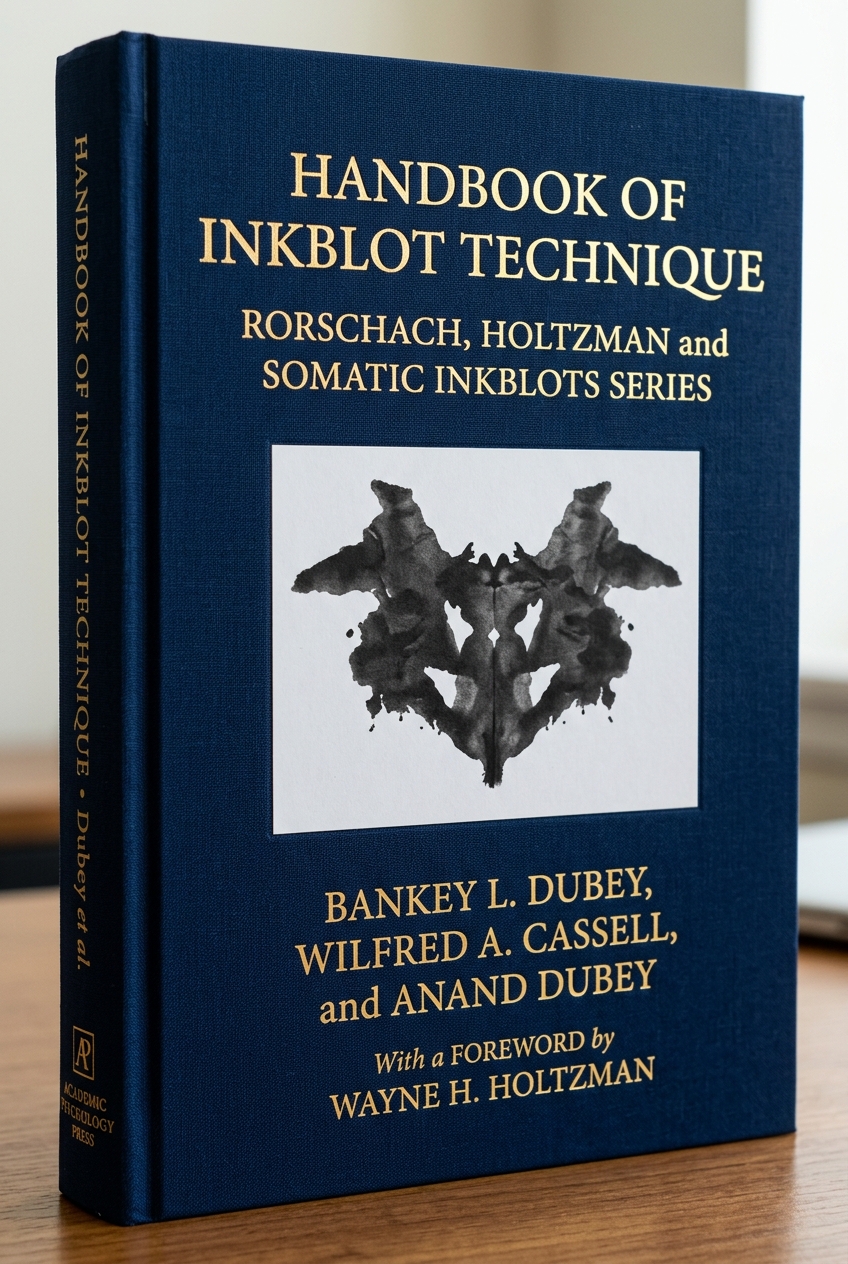
In the late 20th century, Canadian-American psychiatrist Dr. Wilfred A. Cassell, M.D. and international psychometrician Prof. Bankey L. Dubey, Ph.D. revolutionized the field by introducing the paradigm of Somatoperception. Grounded in clinical psychosomatics, neurology, and transcultural mental health, Cassell demonstrated that the human body, its organ systems, and perceived bodily boundaries are direct mirrors of internal psychological conflict.
Together, Cassell and Dubey developed the Somatic Inkblot Series (SIT), standardizing the modern SIT-30 clinical assessment, authoring the landmark 700-page Clinical Handbook, and establishing the SIS Journal of Projective Psychology & Mental Health (founded 1994, Print ISSN: 0971-6610, abstracted in APA PsycINFO).
30 standardized somatic inkblot plates measuring body boundary, organ anxiety, and psychosomatic resonance.
32+ years of peer-reviewed scholarship, 338+ archived papers abstracted in APA's PsycINFO.
Comprehensive database across 14 diagnostic categories: PTSD, oncology, psychosomatics, and psychosis.
🔬 The Science of Ambiguity: How Projective Techniques Work
The neurocognitive and psychodynamic sequence of perceptual projection.
Ambiguous Stimulus
The subject is presented with a semi-structured inkblot or evocative scene that lacks a single pre-determined meaning.
Somatosensory Arousal
Visual processing activates neural networks associated with somatic memory, body boundary awareness, and visceral affect.
Projective Imposition
To resolve ambiguity, the unconscious mind projects its repressed needs, defense mechanisms, and body-image vulnerabilities.
Standardized Scoring
Responses are scored objectively on location, determinants (form, color, movement), content, and somatic locus.
Apperception vs. Somatoperception: A Paradigm Comparison
How the Somatic Inkblot Test expands traditional projective frameworks.
| Dimension | Traditional Apperception (Rorschach, TAT) | Somatoperception (Cassell-Dubey SIT-30) |
|---|---|---|
| Primary Diagnostic Axis | Ego defense mechanisms, cognitive perceptual style, reality testing, and affective balance. | Somatic symptom projection, bodily boundary indices, visceral organ anxiety, and mind-body distress. |
| Stimulus Structure | Purely accidental symmetrical ink spills (Rorschach) or theatrical interpersonal photos (TAT). | Standardized semi-structured plates intentionally designed to evoke somatic resonance & boundary demarcation. |
| Clinical Application | Differential psychiatric diagnosis, thought disorder screening, and personality profiling. | Psychosomatic medicine, oncology distress, PTSD body memory, chronic pain, and workplace executive burnout. |
| Historical Origin | Hermann Rorschach (1921), Henry Murray (1935), John Exner (1974). | Dr. Wilfred A. Cassell, M.D. & Prof. Bankey L. Dubey, Ph.D. (1990s–Present). |
📜 Chronological Dossier: Key Figures in Projective History
Chronological compendium of foundational thinkers who shaped projective psychodiagnostics over 350+ years.
| Year(s) | Pioneering Figure | Key Milestone & Publication | Clinical Significance |
|---|---|---|---|
| 1671 | Athanasius Kircher Germany / Rome |
Ars Magna Lucis et Umbrae | First recorded technique of folding ink on paper to generate symmetrical bilateral patterns. |
| 1857 | Dr. Justinus Kerner Germany |
Kleksographien (50 Inkblot Poems) | First systematic demonstration that ambiguous ink designs elicit involuntary projections from the unconscious soul. |
| 1875 | Karl Ludwig Robert Germany |
Robert's Klecksography (20 Plates) | First to explicitly correlate individual inkblot response patterns with personality traits and neuroses. |
| 1886–1904 | Alfred Binet & Théodore Simon France |
L'Étude Expérimentale de l'Intelligence | First experimental use of inkblots to investigate imagination, mental fatigue, and child cognitive depth. |
| 1917 | Gustav Hens Switzerland / Germany |
Über Formdeutungen beim Kleckssehen | Doctoral thesis under Bleuler analyzing form and movement responses across 60 subjects to quantify fantasy. |
| 1921 | Dr. Hermann Rorschach Switzerland |
Psychodiagnostik (10 Standardized Cards) | Created the definitive 10-plate perceptual diagnostic instrument with objective determinants (F, M, C, Y). |
| 1935 | Henry Murray & Christiana Morgan United States (Harvard) |
Thematic Apperception Test (TAT) | Pioneered structured narrative apperception based on the psychodynamics of internal Needs and environmental Press. |
| 1939 | Lawrence K. Frank United States |
Projective Methods for the Study of Personality | Coined the foundational term "Projective Methods" and established the theoretical paradigm of psychological projection. |
| 1961 | Wayne H. Holtzman United States (Texas) |
Holtzman Inkblot Technique (HIT) | Introduced 45-card parallel forms with strictly one response per card to eliminate verbosity confounding in reliability. |
| 1974 | John E. Exner Jr. United States |
The Comprehensive System (CS) | Unified disparate Rorschach scoring schools into an empirically rigorous normative system supported by 10,000+ protocols. |
| 1990s–Present | Dr. Wilfred A. Cassell & Prof. Bankey L. Dubey USA & India |
Somatic Inkblot Series (SIT-30) & SIS Journal | Pioneered Somatoperception, standardized 30-plate clinical assessment, 700-page handbook, and 104 published case protocols. |
🖼️ Archival Visual Artifacts & Clinical Heritage
Historical photographs and documentation from the Somatic Inkblot Society permanent archives.


Continue Your Projective Investigation
Explore 104 verified projective clinical case studies, examine the foundational biography of our founders, or explore the standardized SIT-30 clinical assessment.